
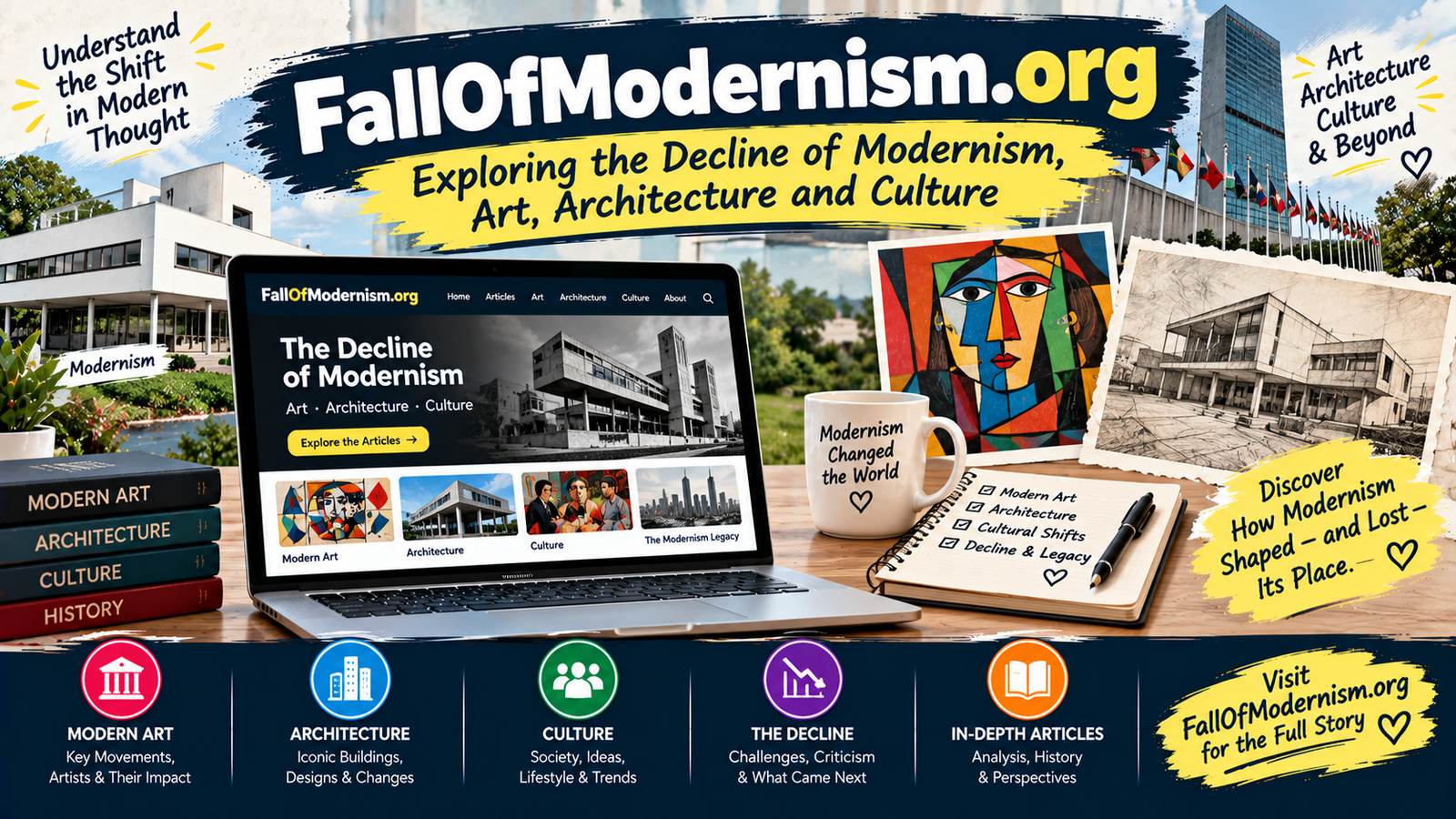
Modernism was one of the most influential cultural movements of the late nineteenth and twentieth centuries. It transformed art, literature, architecture, design, and many other areas of creative expression. Its emphasis on experimentation, innovation, abstraction, technology, and breaking away from traditional conventions changed the way people understood creativity and culture.
Today, the discussion surrounding the Fall Of Modernism.org remains highly relevant. As artistic movements and social values continue to evolve, many people are looking back at modernism to understand its achievements, limitations, and long-term influence. fallofmodernism.org provides a platform for exploring these subjects through articles covering art, literature, architecture, design, and broader cultural developments.
What Is FallOfModernism.org?
FallOfModernism.org is a cultural and editorial website focused on subjects including art, literature, architecture, design, and global perspectives. The site describes its purpose as bringing creativity and critical thought together while examining cultural change and human expression.
The website features different categories and articles that explore artistic developments, architectural ideas, cultural trends, and contemporary issues. Its content demonstrates that the idea of modernism is not limited to paintings or buildings. Instead, modernism can be understood as a much wider cultural phenomenon that influenced how people thought about progress, society, technology, and creativity.
A Brief History of Modernism
Modernism developed during a period of significant social and technological transformation. Industrialization, urbanization, scientific discoveries, and political changes challenged many established traditions.
Artists and writers began experimenting with new ways of presenting reality. In literature, conventional storytelling was often replaced with fragmented narratives and innovative structures. In visual art, abstraction and experimentation became increasingly important. Architecture also moved toward functional forms, new materials, and simplified designs.
Modernism represented a desire to create something new rather than simply reproduce historical styles. It was strongly connected with the belief that creativity could help society move toward a better future.
Why Did Modernism Begin to Decline?
The decline of modernism was not caused by one specific event. Instead, it resulted from several cultural, social, technological, and philosophical changes.
By the second half of the twentieth century, some people began questioning the idea that progress and rational planning could solve society’s problems. Large-scale urban projects and standardized architectural designs were criticized for sometimes ignoring local identity and human experience.
At the same time, new artistic movements challenged the assumptions of modernism. Postmodernism, for example, embraced greater pluralism, historical references, irony, and experimentation.
The Role of Postmodernism
Postmodernism became one of the most important responses to modernist thinking. Rather than believing that there was one universal path toward progress, postmodern thinkers often emphasized multiple perspectives.
In architecture, this could mean combining historical references with contemporary materials. In literature and art, it could involve mixing styles and questioning traditional distinctions between high and popular culture.
The rise of postmodernism therefore did not simply erase modernism. Instead, it challenged many of modernism’s strongest assumptions and encouraged people to reconsider what originality and progress actually meant.
Modernism and Architecture
Architecture is one of the clearest areas in which the rise and decline of modernism can be observed.
Modernist architects frequently emphasized functionality, simplicity, geometric forms, and industrial materials such as concrete, glass, and steel. Buildings were often designed according to the principle that their appearance should reflect their purpose.
While these ideas produced many influential buildings, critics argued that excessive standardization could create environments that felt impersonal. The debate eventually encouraged greater interest in traditional materials, local identity, ornamentation, adaptive reuse, and human-scale design.
Architecture remains an important theme for websites such as FallOfModernism.org because buildings provide a visible record of changing cultural values.
Modernism in Art and Literature
Modernism dramatically changed artistic expression. Artists increasingly rejected the requirement to reproduce the world realistically. Instead, they experimented with color, form, perspective, symbolism, and abstraction.
Literature experienced a similar transformation. Writers experimented with narrative structure, perspective, language, and consciousness. These developments demonstrated that creative works did not necessarily have to follow established rules.
The legacy of these experiments remains visible today. Contemporary artists and writers continue to use many techniques first developed or popularized during the modernist period.
Technology and the Changing Creative World
Technology has always played an important role in cultural development. Modernism itself was partly inspired by technological progress and industrialization.
Today, however, digital technology has created another major transformation. Computers, social media, digital art, artificial intelligence, virtual environments, and online publishing have changed how creative work is produced and distributed.
This creates an interesting connection between modernism and contemporary culture. Modernists embraced technological innovation to challenge old traditions, while today’s creators are using new technologies to challenge established ideas about authorship, originality, and artistic production.
What Can We Learn From the Fall of Modernism?
The decline of modernism offers several important lessons.
First, cultural movements are rarely permanent. Ideas that appear revolutionary in one period can eventually become established traditions themselves.
Second, innovation does not necessarily mean completely rejecting the past. Contemporary creativity often combines historical influences with modern technology and new ideas.
Third, cultural change is complicated. The decline of one movement does not mean that everything associated with it disappears. Modernist ideas continue to influence architecture, literature, graphic design, photography, and visual culture.
Key Topics to Explore on FallOfModernism.org
Readers interested in the website can explore several broad areas:
- Art and Literature – Discussions about artistic movements, contemporary creativity, painting, writing, and cultural expression.
- Architecture and Design – Articles examining buildings, architectural styles, design principles, materials, and the evolution of the built environment.
- Modernism and Its Decline – Content exploring why modernist ideas lost their cultural dominance and how alternative movements developed.
- Cultural Perspectives – Discussions connecting creative expression with wider social and cultural changes.
- Global News and Trends – The site also includes broader global and contemporary topics alongside its cultural content.
Why the Fall of Modernism Still Matters
The discussion about modernism remains important because modernist ideas continue to shape everyday life. From apartment buildings and furniture to books, museums, advertisements, and digital interfaces, many aspects of contemporary culture have been influenced by modernist principles.
Understanding why modernism emerged and why it was later challenged helps readers understand today’s cultural environment. It also encourages a more balanced approach to the relationship between tradition and innovation.
Rather than viewing the “fall” of modernism as the complete disappearance of modernist ideas, it is more useful to see it as a transformation. Modernism became one influence among many, while postmodern, contemporary, traditional, digital, and hybrid approaches created a more diverse cultural landscape.
Conclusion
FallOfModernism.org provides an interesting starting point for exploring the relationship between modernism, contemporary culture, art, literature, architecture, and design. The website’s broad editorial focus reflects the fact that modernism was never simply an artistic style. It was part of a much larger transformation in the way people understood creativity, technology, society, and progress.
The fall of modernism therefore should not be understood simply as the end of an artistic movement. Instead, it represents a shift toward a more diverse cultural environment in which different traditions, technologies, styles, and perspectives can exist together.
By examining both the achievements and criticisms of modernism, readers can gain a better understanding of how today’s creative world developed—and why the conversation about modernism continues to matter.