
Have you ever wondered what is the Longest Word in the Dictionary? It is a fun question that pops into our heads when we see big words in books. Words are amazing building blocks. We use them every single day to talk, laugh, and share our big ideas with our best friends. But some words are super huge. They look like a giant train made of letters chugging across the page. When you try to read them out loud, your tongue might get all twisted up in knots. It sounds like a secret code or a magic spell from a wizard story.
Let us go on a cool adventure together to explore this giant puzzle. We will look at why some words grow so big and how people actually say them out loud without taking a breath. You might even learn a fun trick to surprise your teacher and your friends at school tomorrow. Let us dive right in and uncover the mystery behind the biggest word ever written down in a book!
Discovering the Giant Word
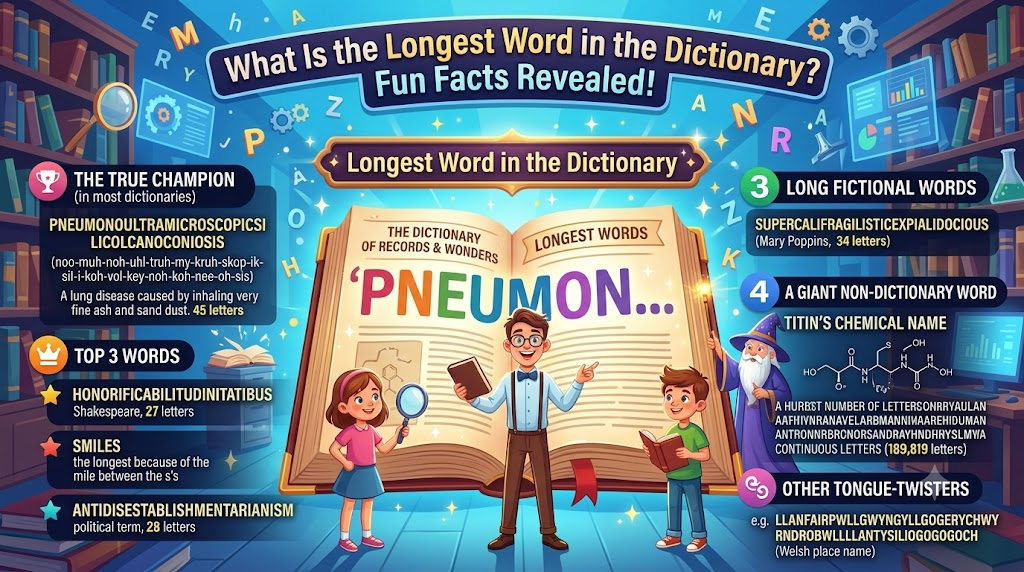
When people ask what is the longest word in the dictionary, they usually want to hear one specific, giant champion. That champion is a monster word with forty-five letters in it. Can you even imagine a single word that takes up a whole line in your notebook? It is so long that your eyes have to take a little jogging trip just to get from the very first letter to the very last one.
People who love word games and puzzles talk about this giant all the time. It is like the heavyweight boxing champion of the alphabet world. Even though it is super long, it is not a made-up word from a silly cartoon. It is a real word that lives inside big official books. Scientists and doctors use it when they need to talk about very specific things in their laboratories. Let us find out what those letters actually spell out and why it is so famous everywhere.
Meeting Pneumonoultramicroscopicsilicovolcanoconiosis
Let us look at the spelling of our giant champion: pneumonoultramicroscopicsilicovolcanoconiosis. Take a deep breath before you even look at it! If you break it down into little bite-sized pieces, it becomes much easier to chew on. Think of it like building with Lego blocks. You take small pieces and snap them together one by one until you have a giant castle. That is exactly how this mega-word was put together by clever people long ago.
Even though it looks scary, it has a cool rhythm when you clap your hands to it. Many students like to practice saying it out loud like a rap song. When you get the rhythm just right, you feel like a spelling champion. It is a fun challenge to try saying it three times fast without making any mistakes. Give it a try right now and see how far you can get before your tongue tickles!
What Does This Lung Word Actually Mean?
You are probably wondering what this giant word actually talks about. Does it mean a giant green monster or a rocket ship flying to the moon? Not quite! It is actually a very specific medical term. It describes a lung disease that people can get from breathing in very fine volcanic dust and ash. Miners and scientists who study rocks sometimes have to be very careful around this kind of dust.
So, every little part of the word has a special job. The first part talks about your lungs. Another part talks about things that are super tiny and microscopic. Other parts talk about fine dust, volcanoes, and getting sick. When you stick all those puzzle pieces together, you get a mini-story hidden inside one single word. Isn’t it neat how language lets us pack a whole scientific idea into a string of letters?
Can You Find It in the Oxford English Dictionary?
Many folks wonder if this giant word sits proudly inside the famous Oxford English Dictionary. The truth is a bit surprising. While big dictionaries acknowledge that people use this word, they often treat it as a technical term or a piece of medical jargon rather than a standard everyday word you would use at the dinner table.
Dictionary makers have a tough job. They have to decide which words millions of people use enough to include in their giant books. Because this forty-five-letter word is so specialized, it usually gets a special mention as a fun curiosity. It is like finding a rare shiny coin hidden at the bottom of a treasure chest. It is real, it is official, but you definitely will not see it on a spelling test in third grade!
Other Long Words in the English Language
English is a very creative language that loves to grow bigger every single year. Besides our volcanic champion, there are a few other runners-up that give it a run for its money. For example, there is a very long word about a fake disease that people made up just to sound super smart. It has thirty-some letters and sounds like a funny potion recipe.
Another famous long word talks about a person who thinks everything is worthless or unimportant. Word nerds love collecting these giant terms like trading cards. Every time people invent new machines or discover new ideas, they create new words to match them. That means our dictionaries are always growing taller and heavier with fresh ideas and cool vocabulary.
Why Do People Create Such Massive Words?
You might wonder why anyone would ever make a word forty-five letters long. Why not just use three or four smaller words to explain the same thing? The main reason comes down to science and precision. In the medical and scientific worlds, experts need exact labels so everyone around the globe knows the exact same thing without any confusion.
Think of it like a special secret code for doctors. Instead of saying a long sentence about dust and lungs every time they write a report, they use one mega-word to save time. It is a shortcut for professionals. Even though it looks wild to us, it serves a very important purpose in the laboratories and hospitals where inventors and researchers work hard every day.
The Science Behind Word Length and Roots
To understand why words get so huge, we have to look at their history roots. English borrows a lot of its building blocks from ancient Greek and Latin languages. These old languages love to glue prefixes and suffixes onto root words like little train cars. When you add a few prefixes about dust, lungs, and size, the train just keeps getting longer and longer.
This is actually a lot like playing with building blocks in your playroom. You start with a simple base block, and then you snap on extra pieces to make your creation taller and cooler. Word creators do the exact same thing when they invent new terms for science. Learning about these roots makes reading big words feel like solving a fun mystery puzzle instead of a chore.
Fun Ways to Practice Spelling Big Words
Trying to spell a giant word can feel like climbing a tall mountain. But you do not have to do it all at once. The best trick is to break the word down into small syllables and clap out each beat. For example, clap once for the first part, once for the middle, and once for the end. This turns spelling into a fun music game.
Another great trick is to write each syllable in a different bright color with your markers. Making art out of spelling helps your brain remember the letter order much faster. You can hang your colorful giant word on your bedroom wall and practice reading it every morning before breakfast. Soon, you will be able to spell it faster than anyone else in your family!
Comparing Dictionary Champions Around the World
English is not the only language that likes to build giant words. Other languages have their own heavyweight champions, and some of them are even crazier! For instance, the German language is famous for smashing whole sentences together into one gigantic compound word. If Germans want to talk about a very specific rule for labeling beef, they make one massive word out of it.
Looking at other languages shows us that humans love to play with sounds and letters in different ways. Every culture has its own unique style of building vocabulary. Comparing these fun word lengths reminds us how creative people are all around our big planet. It makes exploring world languages an exciting adventure for any curious reader.
Summary of Our Giant Word Adventure
We have traveled a long way together exploring what is the longest word in the dictionary. We learned about the forty-five-letter volcanic lung disease champion, looked at how word roots work, and practiced breaking big words down into fun little chunks. Language is truly an amazing playground full of surprises, funny sounds, and clever inventions.
Never be afraid of a big word when you see one in a book. Just take a deep breath, look at the small pieces inside it, and sound it out slowly like a detective. You have what it takes to master any vocabulary challenge that comes your way. Keep reading, keep exploring, and keep having fun with the wonderful world of words!
Frequently Asked Questions
What is the longest word in the dictionary?
The official champion in major English reference discussions is pneumonoultramicroscopicsilicovolcanoconiosis, which contains forty-five letters and refers to a specific lung condition.
How do you pronounce the longest word?
You pronounce it by breaking it down into small syllabus beats. Sound out each little part slowly, starting with pneu-mo-no, and connect them together like building blocks.
Is this giant word used in everyday speech?
No, people do not use it in normal daily conversations. It is a highly specialized medical term that experts and researchers use only when talking about specific dust-related lung issues.
Are there other words that compete for length?
Yes, there are several other runners-up in English, including long chemical names and made-up humorous words like the famous thirty-four-letter word for showing fake Llanfairpwllgwyngyll-style excitement.
Why are some scientific words so incredibly long?
Scientists use ancient Greek and Latin roots to glue descriptive parts together. This creates an exact label so experts worldwide understand the exact same scientific meaning instantly.
Can kids learn to spell this mega-word?
Absolutely! By clapping out the syllables and writing each part in bright colors, anyone can learn to spell and say this famous giant word for fun.
Conclusion
Exploring big words and discovering what is the longest word in the dictionary proves that reading and learning can be a total blast. Language is an endless adventure waiting for curious minds to explore every single day. Why not try sharing this fun forty-five-letter word with your friends or family at dinner tonight to see if they can say it? Leave a comment below with your favorite big word or tell us how fast you could pronounce our volcanic champion!